

Saronic Completes Multi-Day Corsair Deployment with 24/7 Operations

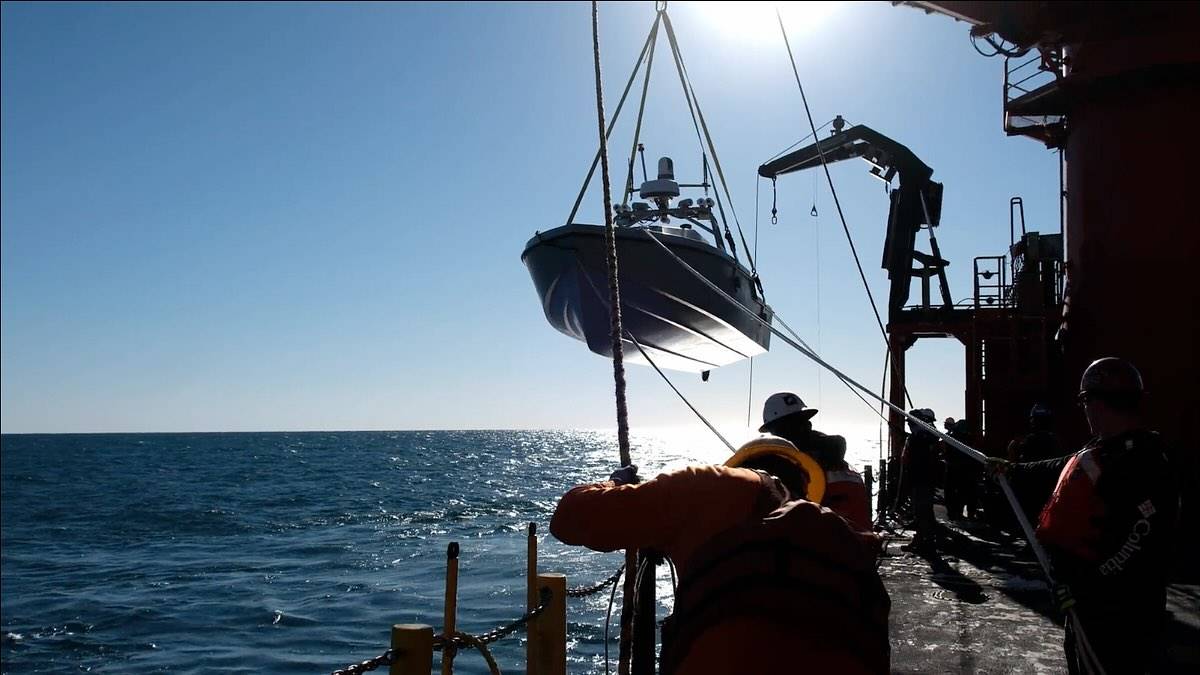
Last month, the Saronic team completed a continuous, week-long, day and night test operation designed to push the limits of Corsair, their 24-foot Autonomous Surface Vessel currently under contract with the U.S. Navy.
Conducted and funded by the company as part of ongoing independent research and development efforts, this exercise ran 24/7 with the goal of accomplishing two things:
- Deeply understand how our vessels perform at — and beyond — their operating limits in real-world environments, and
- Identify improvement opportunities so our systems can evolve as quickly as the threats they are built to address.
Over the course of the exercise, a fleet of eight Corsairs operating more than 70 nautical miles offshore, executed autonomous missions controlled remotely from a dedicated on-shore Joint Operations Center. Saronic Mission Operators worked continuously—both from at-sea support crafts and on land — to sustain Beyond Line of Sight (BLOS) operations without interruption.
To deliberately push the systems, the team conducted a range of demanding missions, including more than 30 autonomous harbor transits, multiple long-distance endurance runs, and continuous loiter operations.
Over the course of the test, the Corsair fleet logged over 4,500 nautical miles — nearly twice the width of the United States.
 Corsair operating in various sea states © Saronic
The vessels operated day and night, across multiple sea states, and in conditions that, at times, could not have been endured by a human operator. The team evaluated opportunities for improvement across both hardware and software, and further validated Corsairs’ performance margins, all of which allow Saronic to continue to improve and advance the platform.
Long-Endurance and Sustained Operations
Many defense and maritime security missions require a vessel to maintain persistent presence for extended periods—holding position, monitoring activity, and remaining ready to respond the moment conditions change. In these scenarios, fuel efficiency, autonomous self-management, and system reliability are critical.
During the exercise, Saronic executed a continuous five-day autonomous loiter operation in which Corsair maintained its position and autonomously regulated power consumption, only engaging the engine when needed to maintain its station.
As a diesel-powered platform, Corsair’s ability to sustain high levels of energy efficiency over extended loiter periods represents a uniquely differentiating capability for USVs in this size category.
Enabled by Corsair’s integrated hardware-software architecture, the Saronic team has demonstrated the ability to support more than 50 days of autonomous loiter. This capability allows operators to maintain persistent maritime awareness without the cost, risk, or fatigue associated with crewed operations.
In addition to long-duration loiter, the exercise validated Corsair’s performance in long-range transit and patrol missions. The team conducted multiple long-range navigation runs, validating Corsair’s 1000+nm range and sustaining operations for more than 92 continuous hours. Throughout these runs, Corsair maintained safe navigation, mission awareness, and demonstrated advanced autonomous behaviors, even in comms-disabled environments.
Further, these runs were executed across a range of sea states, including 5+ foot waves, with no degradation to vessel performance or mission execution.
Together, these operations demonstrate Corsair’s ability to deliver both persistent presence and sustained range, delivering reliable, autonomous coverage in demanding real-world maritime environments.
Data Generation and Software Advancement
The data generated throughout the exercise was invaluable to understanding system and subsystem performance, and where opportunities exist to further advance Saronic’s software and autonomy. Over the course of the week, Saronic collected approximately 500 hours of footage across numerous cameras totaling 17 TB of data. This data will play a critical role in supporting model development, replay and regression testing, and algorithm refinement.
 Corsair collected actionable data and intelligence for Software updates. © Saronic
Additionally, the exercise yielded a few dozen unique and operationally-relevant scenarios in congested waterways that will persist in the Software team’s regression testing suite, which digitally recreates these scenes to evaluate the performance of future software releases. Together, the data generated by Corsair provides actionable intelligence that will be used to continuously improve the system and deliver even greater capability to the water.
Improving End-to-End Operations
Throughout the exercise, Saronic’s Mission Operations team sustained 24/7 operations, an endeavor that requires planning, cross-organizational coordination, and an experienced team. This provided an opportunity to evaluate and refine every phase of the mission execution process — from system configuration to vessel launch and recovery. Operators, engineers, and support teams worked in close coordination to ensure everything functioned reliably under the strain of a sustained operational tempo.
The team also completed successful at-sea launch and recovery during daytime and nighttime operations, demonstrating how larger ships can deploy and retrieve its ASVs without returning to port or interrupting broader fleet maneuvers.
Communication-Denied Intercept
In real threat environments, navigation and communications may be jammed, spoofed, or intentionally left off to avoid detection. Vessels may also need to avoid activating radar, sonar, or other active sensors because any outward emission can reveal their position. In these situations, vessels must rely on passive sensing, navigating quietly using only their internal navigation and what they can see and hear.
This type of navigation is orders of magnitude harder than GPS-supported operation. It is also essential to maritime missions in contested areas.
Saronic ran multiple intercept missions with simulated communication-denied environments both day and night and across varying sea states. This capability is increasingly important for maritime forces as they seek to tackle communication-denied or degraded operations.
Across the six-day exercise, Saronic’s Mission Operations team sustained 24/7 operations, deliberately stressing Corsair across sea states 2–5. The testing allowed us to understand how much stress and damage the vessels can absorb while remaining mission-capable.
This type of real-world testing supports our goal of delivering the most capable autonomous maritime systems possible for the U.S. Navy, our allies, and the broader maritime industry.


